Travez Product Design
What is Travez?
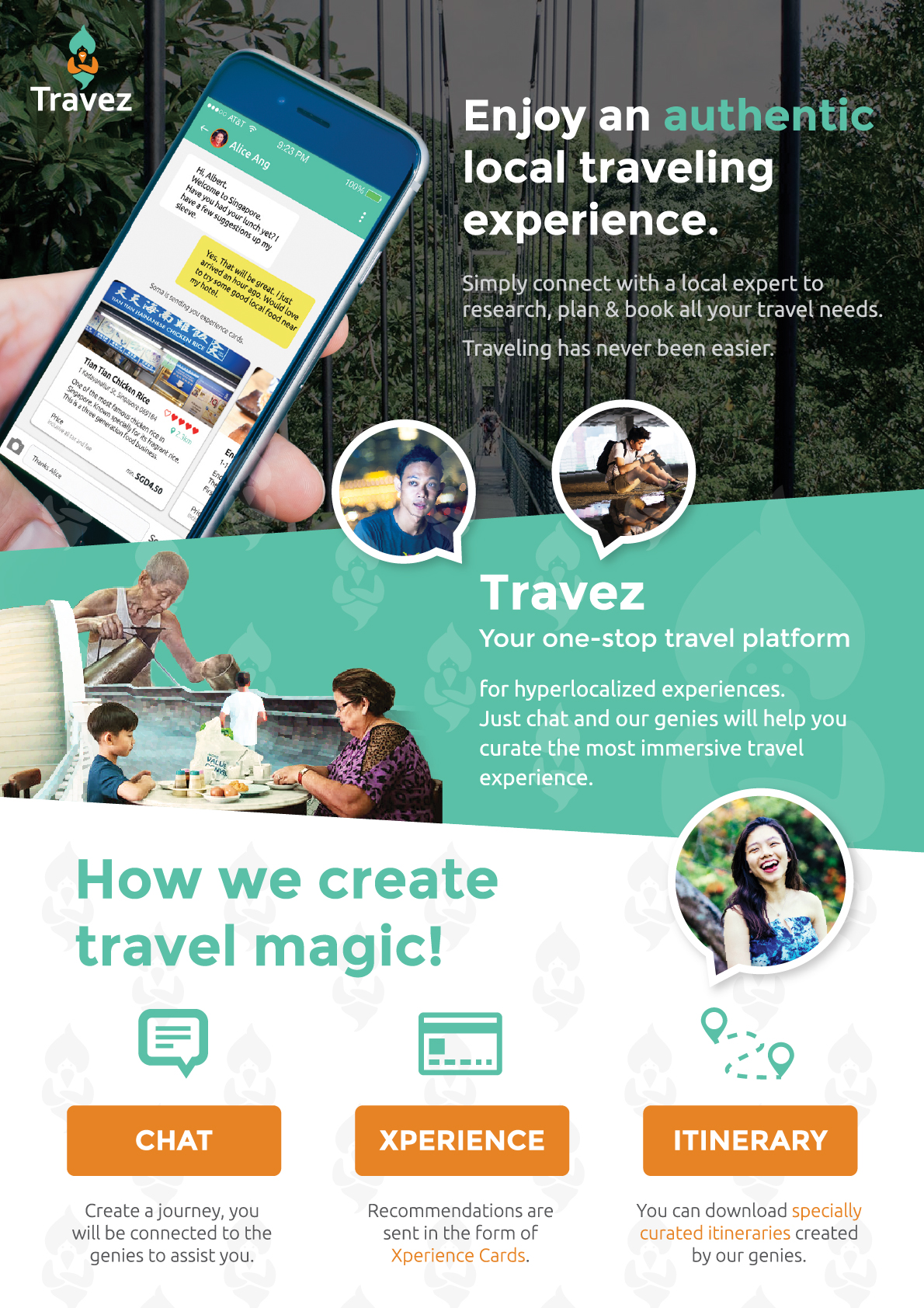
- Travez is an online chat application aimed at redefining the way we plan and discover travel by connecting travellers to local guides.
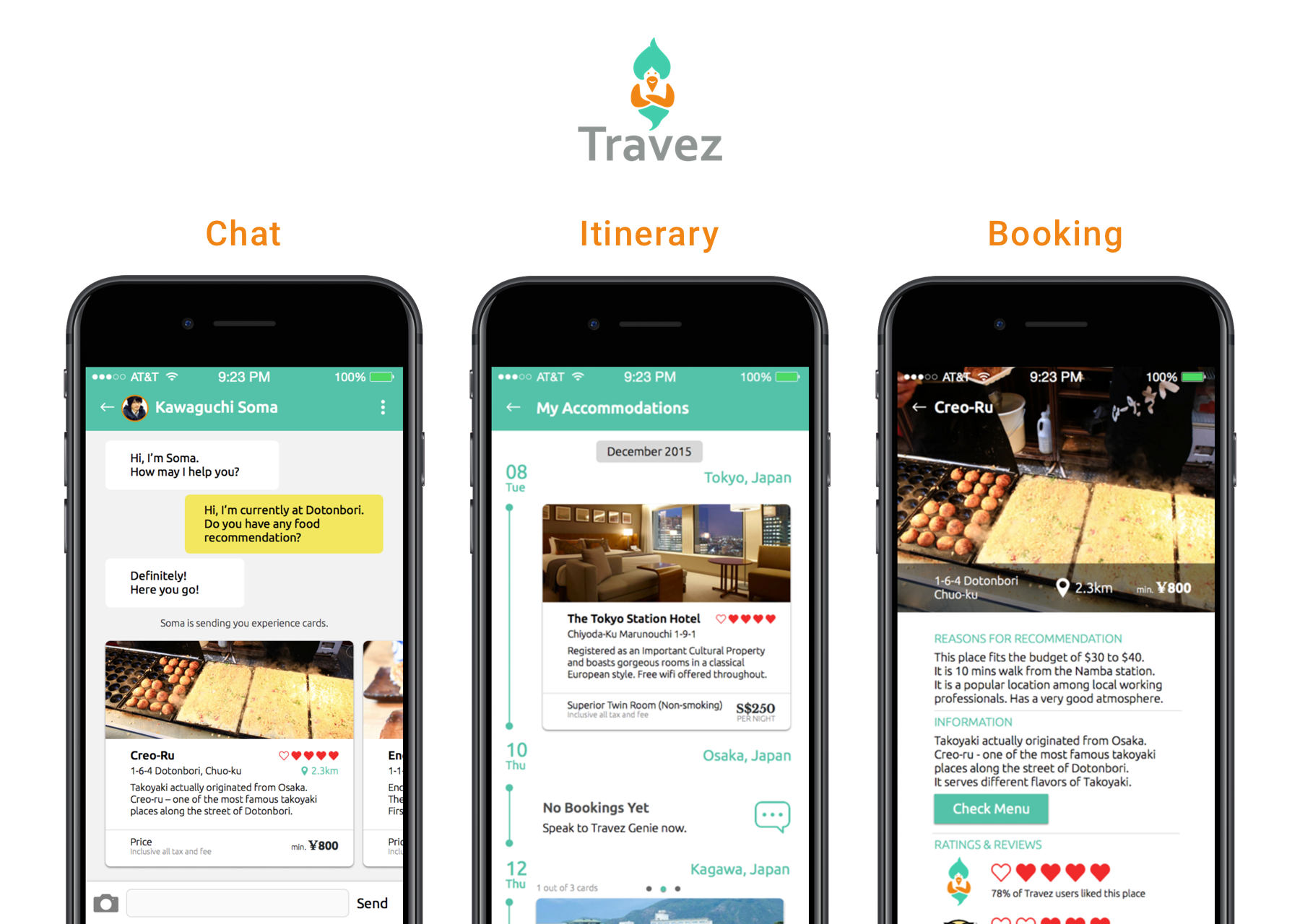
- Through chat, travellers are able to get trip recommendations, automatically consolidate their itinerary in one place and explore unique local experiences in one place.
- Local guides were given access to a backend recommendation engine and experience card creator to help with the trip recommendation process.
What happened?
- After raising $30k, I designed and with the help of contract developers, the MVP for the product was built and at its peak, Travez supported more than 200 travelers.
- This process helped me to learn how to get your first 100 customers, design and implement your product rapidly to validate ideas and truly understand that product and traction needs to go in tandem.
The Product:
Mobile Application
Website
What’s the user challenge?
- The user experience of discovering and planning travel is highly disjointed and ineffective.
- On average, it involves more than 80 hours of research, booking and planning across at least 8 different platforms.
- All this research and planning is driven by the need to maximise the travel experience overseas.
One way to look at the challenge is to see travellers as their own designers of their travel experiences. How might we help optimize this design process for travelers?
How did we go about researching and designing the product?
*TLDR:
- Applied a design process that adapted Human-Centered Design with Lean Methodology.
- Created user personas, conducted lean experimentations, ran design sprints to build MVP product features interacting with more than 100 customers & stakeholders.
- Focused on alleviating the “half-cup empty” mindset of travel planners.*
Combining HCD with the lean methodology, it not only helped to shorten research and design sprints for early start-up gestation, it also guided a rapid UX research process. Every opportunity to interface with users was also an opportunity for lean experimentation to test business hypotheses.
Major insights gathered through in-depth interviews were quickly weighed based on the lean framework of “Leap of Faith”. The aim is to validate assumptions that required us to a leap of faith.
To illustrate this process, I began the UX research process with a focus on uncovering travel behaviours around planning and discovery. One key takeaway was was that planning for a traveler while not necessarily a pleasant experience, helped them to derive a sense of safety and assurance, as if they have completed their ‘homework’ to travel. Hence, time will be well spent during the travel. However, planning did not guarantee a satisfactory travel experience. As I reviewed many recounts, I observed in planners a half-cup empty mindset when they recollect about their trip. They focused a lot on what they couldn’t complete on the trip and lamented about the lack of a sense of fulfillment where they felt that they never fully explored the place. On the contrary, travelers who ‘went with the wind’ displayed a greater sense of fulfillment despite spontaneous travel decision and recommendations by locals.
Upon uncovering this insight, the challenge was to determine how our product could balance this sense of assurance while ameliorating the tedious experience of travel planning. Due to resource and time constraints, I was unable to conduct further interviews to map out our planning models and behavioral patterns. I was pressed for time as a solo founder and wearing multiple hats to keep the startup afloat. Adopting the lean model, I was able to transit from research to product features design quickly by running lean experiments. One way to help guide the product direction, we let a set of test users choose between an itinerary checklist versus a planning process that involved speak with a guide and designing their own itinerary. While the initial reaction was to always get the checklist, 92% of the users indicated that speaking with an individual to get insights on what to do on the trip were much more helpful and all of them will be taking up the recommendation provided by the individual.
The research and experimentation process was fast and took 1 to 2 days. The idea was to validate and be willing to kill our best ideas as quickly as possible as part of the agile development process. As such, it was decided that the final product should not focus on simply building a better research tool to help plan trips but rather also provide a human connection in the planning process such that it is not a checklist way of discovering travel but rather, about discovering the cup that is half-full.
Throughout the research process, I was really encouraged by all the help we got with more than 100 stakeholders and customers engaged. At least a dozen of lean experimentation were conducted to validate the customer and problem hypothesis to form our initial solution and MVP design.
What’s the solution:
The product tapped on three main product goals based on the initial research:
- Travelers almost always act on recommendations that they receive from their friends, family or locals.
- Travelers enjoy the process of discovering their travel plans (autonomy) but hate the process of consolidating or optimizing their travel plans.
- If given a choice, they would like to have an authentic travel experience that they could attain social currency with. Something that is non-mainstream and uniquely local.
Key product features for users:
- Connect travelers with local guides via chat.
- Automatically generate an itinerary by streamlining recommendations, booking and planning using the proprietary experience cards and itinerary system.
- Discover uniquely local experiences hosted by local guides.
Key product features for guides:
- A recommendation engine powered by crowdsourced answers and machine learning
- An itinerary creator engine using experience cards as building block
- Internal points, badge and leaderboard system to encourage answering of questions
Branding & Marketing:
Pitch Deck
Flyer